Your IT department reports that the systems are secure, yet your personal liability remains exposed. For an Australian board director, the critical question isn't whether the servers are running; it's whether your oversight is legally defensible under ASIC and APRA scrutiny. You likely feel the weight of information asymmetry, where technical jargon obscures the actual strategic risk. Many directors view the process as a mere checkbox exercise, but understanding what is it audit in a modern governance context is the difference between a technical green light and a robust fiduciary defence.
With the release of the ISACA ITAF 5th Edition on 26 February 2026 and the mandatory IIA Cybersecurity requirements effective since 5 February 2026, the landscape of digital trust has shifted. This guide transforms technical compliance into a powerful governance tool. You'll discover how to define a rigorous audit scope and learn the specific questions that cut through corporate noise during board meetings. We'll move beyond abstract data to establish a clear accountability matrix that protects both the organisation and its leadership.
Key Takeaways
- Recognise the IT audit as a strategic governance bridge rather than a simple technical health check.
- Understand what is it audit in the current regulatory climate to ensure your oversight meets the highest standards of fiduciary duty.
- Move beyond 'green' checkbox reports to build a defensible position against scrutiny from ASIC and APRA.
- Master the specific questions that cut through corporate noise to reveal material risks threatening your firm’s reputation.
- Learn how to transform audit findings into a structured accountability matrix for long-term strategic resilience.
What is an IT Audit? Defining Digital Governance in 2026
Directors often mistake an IT audit for a routine technical scan. It's a dangerous oversimplification that leaves boards exposed. At its core, an information technology audit is an independent, rigorous examination of your organisation’s digital infrastructure, policies, and operational execution. In the Australian corporate landscape, this process validates whether your technology assets align with both statutory requirements and your stated business strategy. It isn't a task for the IT department to mark its own homework; it's a governance lever for the board.
Think of it as a structural integrity test rather than a simple health check. While a health check might confirm a system is currently "running," a structural integrity test asks if it will hold under the pressure of a sophisticated cyber attack or intense regulatory probe. For a director, understanding what is it audit standards require in 2026 means moving from passive trust to active, evidenced verification. It's about ensuring the foundations of your firm are fit for purpose.
The Core Purpose: Beyond the Technical Checklist
The primary goal of an audit is to establish an objective baseline of truth. Internal IT reports often suffer from optimism bias or a lack of broader context. An audit identifies the gap between your written policies and the actual operational reality on the ground. This transparency is vital for establishing a defensible position. If a breach occurs, the board must prove it exercised due diligence. A comprehensive Cyber Governance Readiness Review ensures that your oversight is not just a checkbox, but a robust shield against regulatory scrutiny.
IT Audit vs. Financial Audit: The Critical Difference
Financial audits are retrospective; they verify what has already happened to the cent. IT audits are predictive; they assess what *could* happen to the entire enterprise. While your financial auditor might perform a cursory review of "IT general controls," this rarely goes deep enough to satisfy your fiduciary duties under AICD standards. In 2026, technology risk underpins every line on your balance sheet. Relying on a financial audit to catch systemic IT governance failures is like checking the fuel gauge to see if the brakes work. You need a specialised lens to ensure the firm's resilience.
The Anatomy of a Modern IT Audit: Scope and Standards
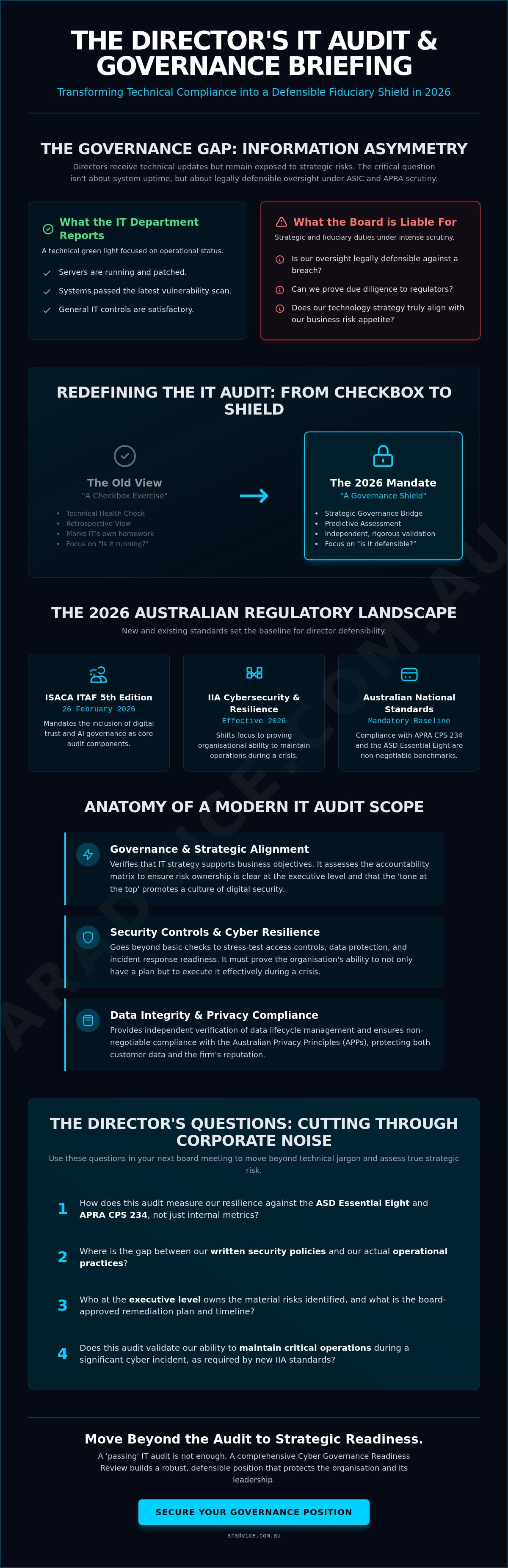
The scope of a 2026 audit has expanded far beyond the server room. It now encompasses your entire digital ecosystem, from cloud-native applications to the intricate web of third-party APIs. For a director, knowing what is it audit requirements demand today means looking at data and identity rather than hardware. You're no longer auditing boxes; you're auditing the flow of value and the integrity of your firm's reputation. This transition is codified in the ISACA ITAF 5th Edition, released on 26 February 2026, which now mandates the inclusion of digital trust and AI governance as core components of the audit process.
In Australia, your baseline for defensibility is set by the ASD Essential Eight and, for regulated entities, APRA CPS 234. These aren't suggestions. They're the frameworks by which your oversight will be judged during a regulatory inquiry. If your audit doesn't measure performance against these specific standards, it isn't providing the fiduciary protection you need.
Governance and Strategic Alignment
Does your IT strategy actually support your business objectives, or is it a siloed operation? An effective audit reviews the accountability matrix to ensure risk ownership is clear at the executive level. It assesses the 'tone at the top', verifying that digital ethics and security are integrated into the corporate culture rather than treated as a technical nuisance. This alignment ensures that technology spend is a strategic investment rather than a black-hole expense.
Security Controls and Cyber Resilience
Testing access controls is fundamental. Who can see your most sensitive data? The audit must also stress-test your incident response readiness. Having a plan is insufficient; you must prove the ability to execute it. With the IIA Organizational Resilience requirements effective as of 30 April 2026, the focus has shifted toward your ability to maintain operations during a crisis. A Cyber Governance Readiness Review can help bridge the gap between technical plans and board-level confidence.
Data Integrity and Privacy Compliance
Compliance with the Australian Privacy Principles (APPs) is a non-negotiable duty. Your audit should verify data lifecycle management, ensuring you aren't retaining 'toxic data' that increases your liability. It must also address data sovereignty. If your data sits in a cloud environment, you must know exactly which jurisdiction governs it. As AI becomes ubiquitous, an AI Governance Readiness Review is now essential to ensure these new systems don't inadvertently compromise your privacy obligations or ethical standards.
Compliance vs. Defensibility: Why 'Passing' Isn't Enough
A "green" audit report is often the most dangerous document in the boardroom. It creates a false sense of security that can mask systemic governance failures. Many directors mistakenly believe that a successful audit means the organisation is safe from harm. In reality, a standard audit often only confirms that you have met a minimum set of technical requirements at a single point in time. When considering what is it audit outcomes represent, you must distinguish between mere compliance and true defensibility. Compliance is the floor; defensibility is the ceiling you must reach to protect your personal liability and the firm's reputation.
The most common objection from executive teams is the "certification shield." They might argue that because the firm is ISO 27001 certified, the board's duty is discharged. This is a fallacy. Certification proves you have a management system; it does not prove that your controls are effective against a 2026 threat landscape. This "audit theatre" provides impressive metrics while leaving the actual risk unmitigated. If a breach occurs, ASIC won't ask if you had a certificate. They will ask if you exercised proactive, informed oversight of the underlying risks.
The Limitations of Checkbox Audits
Technical teams can easily game a checkbox audit by preparing specifically for the testing window. These point-in-time assessments are static, whereas cyber and AI risks are dynamic. A clean report from six months ago offers zero protection against a vulnerability discovered yesterday. Relying on these reports without deeper interrogation can lead to significant regulatory settlement agreements. The gap between "technical pass" and "strategic safety" is where most board-level exposure resides.
Establishing Defensible Oversight
Defensibility requires you to move from trusting the report to verifying the mechanism of control. You don't need to understand the code, but you must understand the accountability matrix. This involves using independent insights to interpret what the audit findings actually mean for your fiduciary duties. A Cyber Governance Readiness Review helps you move beyond the "trust me" model of IT reporting. It provides the structured evidence needed to demonstrate that the board has met its obligations under Australian law, ensuring your position is secure even under intense regulatory scrutiny.
The Director’s Question: Navigating the Audit Report
Directors don't need to be coders. You need to be an expert interrogator. When an IT audit report hits the boardroom table, it often arrives wrapped in technical jargon designed to soften the impact of systemic failures. Your role is to cut through this noise to find the material risks that threaten your firm's reputation. Truly understanding what is it audit reports reveal requires a shift from passive reading to active interrogation. If you can't explain the risk in plain English, you can't govern it.
Watch for red flags that signal a lack of depth. Vague language like "generally compliant" or "ongoing improvements" often masks significant vulnerabilities. If the report relies heavily on staff interviews rather than direct technical testing, the findings are likely superficial. A defensible position is built on evidence, not assertions. If the audit feels like a routine box-ticking exercise, it probably is. You must demand the same level of precision from your technology reporting as you do from your financial statements.
Interrogating the Findings
Use these specific questions to challenge the status quo during your next board meeting:
- What was the most significant risk the auditor *didn't* look at? Every audit has a scope limit; you must know what was left in the shadows.
- If this control failed today, how long would it take us to realise? This measures your detection capability, which is often more critical than the control itself.
- How does this finding impact our legal obligations under the Privacy Act? Connect technical gaps directly to your fiduciary and regulatory liability.
Driving Accountability
Remediation must be swift and measurable. Management responses that are merely aspirational offer no protection under Australian law. You need clear timelines and assigned owners for every high-risk finding. Link these outcomes directly to executive KPIs to ensure security isn't sidelined by operational convenience. If your current reporting lacks this level of clarity, a Cyber Governance Readiness Review provides the independent oversight needed to fortify your accountability matrix. An audit is only as valuable as the actions it triggers.
Beyond the Audit: Moving to Strategic Readiness
An audit report sitting in a drawer is a liability, not an asset. It represents the start of the conversation, not the conclusion of the board's duty. Understanding what is it audit protocols require for 2026 is only the first step. Once the findings are on the table, the focus must shift to strategic readiness. Andrew Roberts Advisory specialises in turning these technical insights into board-ready governance frameworks. Traditional audit cycles are often too slow for the 2026 threat landscape. We address this with our 48-hour readiness review, delivering high-impact results at the pace of executive decision-making. We bridge the gap between what IT reports and what the board needs to know to maintain a defensible position.
Facilitating Board-Level Simulations
An audit tests systems, but a simulation tests your leadership. You must test the human element of governance before a crisis occurs. Moving from theoretical risk on a page to practical crisis leadership is a core fiduciary responsibility. A Cyber Governance Readiness Review provides the evidence-based foundation for these simulations. It ensures your response is reflexive rather than reactive. This shift from paper safety to operational resilience is exactly what regulators examine during a post-incident inquiry. It proves that your oversight isn't just a policy; it's a practice.
The Role of Independent Advisory
You need an advisor with no conflicts of interest to interpret audit data. Many auditors are tied to vendors or technical implementation teams, which can cloud their objectivity. We maintain a strict No Conflicts of Interest manifesto, ensuring our advice is purely for the board's protection. Establishing a permanent culture of defensible oversight is the only way to move beyond annual panic. It ensures you meet your obligations under the eyes of ASIC and APRA consistently. Secure your board's legacy with independent governance oversight that stands up to the highest levels of regulatory scrutiny.
Securing Your Defensible Position
A technical pass on an IT audit doesn't discharge your fiduciary duty. True oversight requires you to move from passive acceptance of "green" reports to active interrogation of the accountability matrix. By refocusing on defensibility rather than mere compliance, you protect the organisation and your personal liability from the scrutiny of ASIC and APRA. Understanding what is it audit frameworks demand in 2026 is your first step toward building a resilient corporate legacy.
You need a partner who speaks the language of the boardroom, not just the server room. We provide independent, board-level expertise with a strict no-conflicts policy, ensuring our advice is always aligned with your strategic safety. We don't sell technical fixes; we provide the clarity you need to govern with confidence. Book a Cyber Governance Readiness Review with Andrew Roberts Advisory to fortify your oversight. You can meet the challenges of the digital age with structured, defensible readiness.
Frequently Asked Questions
Is an IT audit the same as a penetration test?
No, they are distinct exercises with different goals. A penetration test is a tactical simulation designed to exploit specific technical vulnerabilities. An IT audit is a strategic review of your entire governance framework, policies, and internal controls. While a pen test shows if a door can be kicked in, an audit evaluates the accountability and monitoring systems that ensure the door remains locked.
How often should an Australian board commission an IT audit?
Annually is the minimum baseline for most Australian firms to maintain a defensible position. With the release of the ISACA ITAF 5th Edition on 26 February 2026, the industry has moved toward a model of continuous assurance. Boards should trigger an immediate review if the organisation undergoes a 20% change in infrastructure or adopts new, high-risk technologies like generative AI.
Can our internal IT team conduct their own IT audit?
Independence is the cornerstone of defensible oversight. Internal teams cannot audit themselves because they lack the objectivity required to report on their own operational failures. For a director to meet the standard of care under ASIC scrutiny, the audit must be conducted by an unbiased third party. Self-auditing is essentially marking your own homework and offers no protection during a regulatory inquiry.
What are the legal consequences for directors if an IT audit is ignored?
Ignoring audit findings can lead to personal liability under Section 180 of the Corporations Act 2001. If a breach occurs and it's proven the board failed to act on identified risks, directors face potential disqualification or significant civil penalties. In 2026, regulatory bodies like APRA and ASIC increasingly view digital negligence as a direct breach of your core fiduciary duty to act with care and diligence.
What is the difference between an IT audit and a cyber security audit?
An IT audit examines the broader technological infrastructure including efficiency, lifecycle management, and operational alignment. A cyber security audit is a specialised subset focusing strictly on protection against threats. When determining what is it audit scope should include, directors must ensure it encompasses both general operational health and specific cyber resilience to meet the digital trust standards established by NIST CSF 2.0.
How much does a comprehensive IT audit typically cost for an AU firm?
Costs vary based on the complexity of your digital ecosystem and the specific regulatory frameworks involved. Mid-market firms should expect to invest based on the depth of the review and the scale of their data holdings. Boards must view this as a necessary governance investment rather than a discretionary expense. The cost of a thorough audit is a fraction of the average $4.5 million cost associated with a major data breach in Australia.
What is the 'Essential Eight' and should it be part of our audit?
The Essential Eight is a prioritised list of mitigation strategies developed by the Australian Signals Directorate (ASD). It is the primary benchmark for cyber maturity in Australia. Your audit must include an assessment against the Essential Eight Maturity Model to provide a clear, actionable roadmap for fortifying your technical defences. This ensures your organisation meets the baseline expectations of the Australian Cyber Security Centre (ACSC).
What happens if our IT audit reveals a significant breach?
Immediate escalation to the board and external advisors is required under the Notifiable Data Breaches (NDB) scheme. You have a legal obligation to conduct an assessment within 30 days to determine if the breach is likely to result in serious harm. Failure to report an eligible breach to the Office of the Australian Information Commissioner (OAIC) can result in fines exceeding $50 million for serious or repeated privacy interferences.